
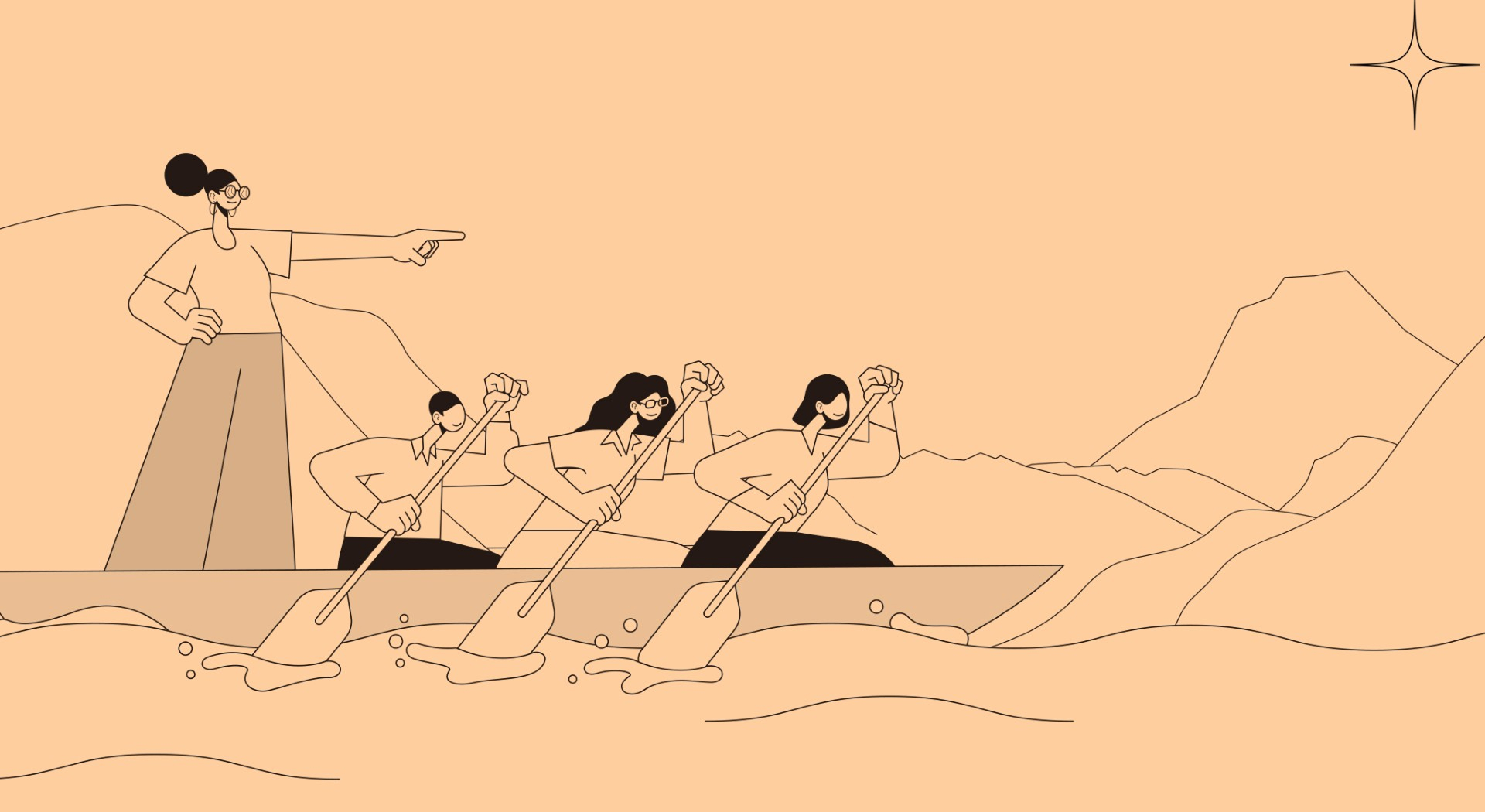
Your roadmap is a security blanket.
Comfortable, familiar. And no substitute for knowing where you're actually going. It keeps teams moving, stakeholders happy and sprints on track. But here's what it can't do: tell you where you'll be in three years.
You have a strategy that stretches two, maybe three years. Your roadmap covers the next six months. But what does it actually look like?
If you can't articulate where your product will be in three years, your competitors already have the advantage. And if you can't show your board, your product team, your marketing team and your CFO a coherent picture of that future, you risk everyone working in different directions.
The problem isn't strategy. It's vision.
You know your company's goals, your customer segments, your competitive positioning. The strategy has frameworks, revenue targets… and a lot of slides.
Vision is different. Vision asks you to conceive of a future that doesn't yet exist, and then make it feel real enough that fifty people will organise their work around it. That's a different skill, and it's one most teams have never been asked to develop.
The result will be familiar: teams work hard, roadmaps get delivered, and quarterly planning ticks over. Product, engineering and marketing are technically aligned but practically running in different directions. The roadmap is full of sensible decisions that somehow don't add up to anything bold. And when the board asks 'where is this product going in three years?' your answer is vague. Not because your team isn't talented. But because no one has ever connected the dots.
The good news: connecting the dots is a practice, not a talent. And organisations that invest in it don't just feel more confident. They build demonstrably better products.
What a great product vision actually does
Done well, a product vision does three things, and each one makes the next easier.
It bridges strategy and execution. A vision translates high-level company ambition into something tangible enough for a designer (or these days, anyone!) to prototype and an engineer to estimate. Without it, strategy lives in the boardroom and execution lives in Jira, and the two rarely meet.
It aligns teams around a shared destination. When product, engineering, marketing and finance all see the same picture of the future, their decisions, even small ones, start to compound in the same direction instead of cancelling each other out. Alignment stops being a meeting agenda item and starts being the default.
It builds confidence in your roadmap. When you know where you're going, you can evaluate whether any given feature or initiative is moving you closer or further away. You’ll always need to make changes, but it’s easier to tweak or pivot with an end goal to steer towards.
The playbook: five principles for building a vision that works
1. Hit the time horizon sweet spot
Three years. Not one, not ten.
A one-year horizon is just your roadmap with better lighting. It doesn't create the psychological distance needed to imagine differently. Teams default to solving the problems they already know, within the constraints they already have.
At the other end of the spectrum, I once led a team to construct a 10-year strategic vision for Xero. We mapped a wide range of macro trends: workforce shifts, globalisation, the digitisation of compliance.
With the benefit of hindsight, the limits of this long-range speculation become glaringly obvious. While we accurately predicted some trends (e.g. that 'human expertise will be augmented, rather than replaced, by data and AI'), others have been entirely derailed or stalled. Ultimately, this exercise revealed a fundamental truth that futurists often obscure: looking a decade out introduces too many variables. As time extends, the cone of plausible futures rapidly widens, and strategy inevitably veers into guesswork.
Three years sits in the zone of reasonable foresight, ambitious enough to inspire innovation, close enough to plan toward. The goal isn't to predict the future. It's to provide enough direction to act with conviction.
2. Show, don't tell
Your board reviews strategies constantly, yet this is exactly where many product visions fail. The thinking is sound, but because the future is merely described, not shown, there is too much room for misinterpretation. When the future lives only in people's heads, it's different in every head.
That was the challenge when we began work on a new tourism experience vision for RealNZ. Some of the board were focused on the numbers and some on imagining a future they couldn't quite articulate. Everyone was talking about the same project and picturing something different.
Prototypes resolved it. Not by answering every question, but by giving everyone the same thing to react to. They gave stakeholders something to point at and say 'Yes, that' or 'No, not that.' This specificity pulled the conversation out of the abstract and into the specific. Yes or no. Worth pursuing or not. Good visual representations don't just show the future, they force the decisions that get you there.
3. Create the conditions for vision thinking
Vision work cannot be done as a side project. And this isn't about how talented your team is or how much effort they put in.
The teams best placed to build a product vision are often the least equipped to do it. They're embedded in BAU, rewarded for execution, and measured on delivery. Working within constraints is exactly the right mindset for shipping (or ‘versioning’), and exactly the wrong one for envisioning.
Freeing a team to think in vision mode requires a deliberate shift in conditions and mindset, not just a workshop on the calendar. A few approaches that work:
Carve out protected time. Get it signed off.
Vision thinking done in the margins of BAU produces marginal visions. Getting leadership aligned on a dedicated window (4–8 weeks, depending on the scope of internal and external engagement needed) signals that this work is real and that the outputs will be taken seriously.
Bring in disruptors alongside SMEs
Your subject matter experts know the space deeply, but that depth often works against them, surfacing statements like 'we've tried that before' or ‘there are too many dependencies’. Introduce people who don't know the category but understand adjacent disruptions e.g. fintech thinking applied to healthcare or consumer UX applied to B2B tools. This mix of minds can act as the catalyst for new solutions.
Ask the uncomfortable question
One of the most effective provocations we use is "If a well-funded, ruthless competitor set out to destroy our product, what would they build?" The answers are often uncomfortably close to what you should be building yourself.
We recently ran exactly this exercise with our own internal team. It was truly uncomfortable for many of us, but also inspiring. Much like how a touch of fear indicates you are truly challenging yourself, a slightly scary idea is typically a strong sign that you are onto something promising.
4. Vision work is collaborative by design. Not by committee.
A successful product vision is never the work of an isolated team. When a vision is developed in isolation and handed down, it almost always fails, not due to flawed logic, but because of a lack of shared ownership across the organisation.
To land well, a vision must be built with the right people. Ideally this is a working group that bridges disciplines:
- Research and Design: grounding the vision in real customer needs and bringing future states to life visually
- Engineering and Data Science (if digital): stress-testing technical feasibility early to ensure the vision remains ambitious, but not fantasy
- Product and Strategy: anchoring concepts to business viability and ensuring the direction maps to where the business is actually going
The goal of bringing these disciplines together is not consensus. Consensus produces watered-down visions. The goal is the early detection of tensions, likely due to commercial, technical or cultural friction. Much like the act of prototyping itself, surfacing those tensions during the vision phase is vastly cheaper than discovering them during delivery.
When working on a product vision for Fonterra farmers, the team embedded a solution architect in the working group from the start. As our research surfaced how farmers actually think about capturing and using their data, the architect shaped the data model around those insights in real time. The vision and the architecture evolved together, which was only possible because the right people were in the room from day one.
Equally important is engagement with leadership throughout. Senior stakeholders cannot simply be presented a ‘fait accompli’ at the finish line. They need to be brought along throughout the process. Here are three tools that have proven invaluable to us:
- Upfront stakeholder mapping: defining who needs to be consulted, informed, or involved
- Structured check-ins at key milestones: replacing ad hoc updates with reviews at critical pivot points
- Prioritisation frameworks: evaluating every concept against desirability, feasibility, and viability, to ensure the vision is valuable to both customers and the business… and can actually be built.
5. Your customer is not a market segment
Intentionally or not, strategies often think of customers in TAM, SAM, SOM terms, rather than humans with needs and behaviours. It’s the job of the vision to bring customers into the foreground. A good vision is built at the intersection of strategic goals, new technologies, and vitally: a clear view of your customers and the problems you will solve for them. When we created a vision for the future of the Air New Zealand aircraft experience, our first task was to describe five key customer groups that research showed we would need to cater to in the future.
Speaking of research, if you're tempted to skip testing your vision, the thinking probably goes: these concepts won't ship as designed, so why invest in testing them? Or: we built this vision off of our known customer pain points, so we’re pretty sure we got it right. Creating a vision is about building the confidence to make bold decisions, so it makes sense to ensure you’re separating the directions worth investing in from the ones that feel exciting internally… but miss the customer entirely. And given how much resource a product vision influences, including what you decide not to build, the cost of getting it wrong is high.
Do customers lean forward when they see this? Does this concept address a need they couldn't articulate before? The bar isn't perfection. It's directional confidence. A vision tested with the right customers gives you something no internal consensus can: confidence that you're building in the right direction.
The north star as a competitive advantage
Product visions aren't a luxury for large companies with dedicated strategy teams. They're a competitive necessity for any organisation with a product that will need to be different in three years than it is today. Which is most of them.
The organisations that build this practice don't just make better product decisions. They build the confidence to make bold ones. They give their boards something to fund. They give their engineers something to build toward. And their designers have a foundation to push forward from. In a market where the pace of change keeps accelerating, boldness backed by a clear vision is the closest thing to a competitive moat.
The question isn't whether you should build a product vision. It's whether you do it now, or wait until a competitor has already built theirs.